Take Control of Your Carbon Data and Reporting with Achilles
Purpose-built for growing businesses, Achilles Carbon Accounting automates carbon footprint measurement and simplifies emissions reporting. Stay compliant, hit sustainability goals, and focus on what matters.
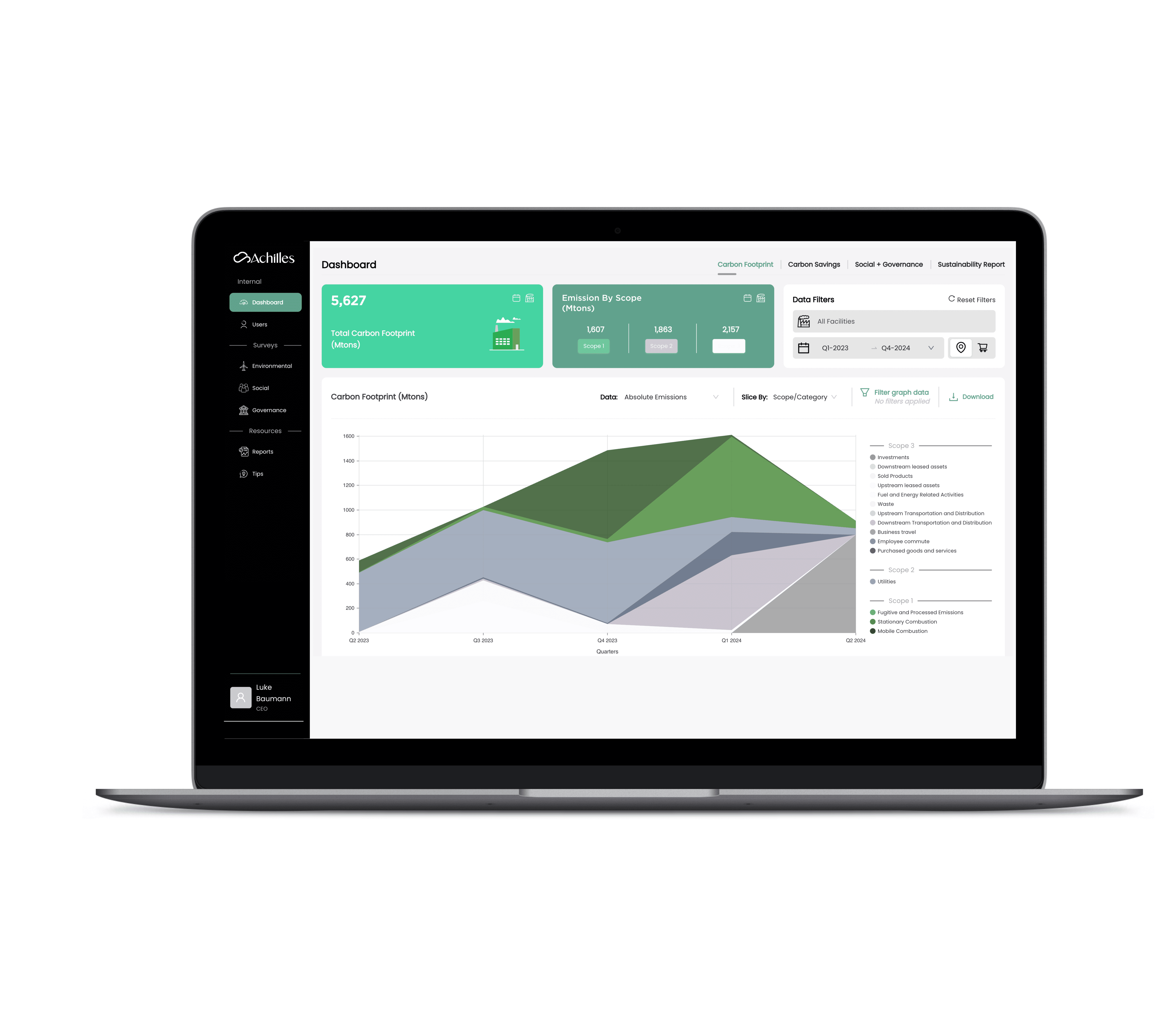
Streamlined Carbon Footprint Reporting
Achilles Carbon Accounting software helps businesses automate and streamline their carbon footprint measurement and reporting processes. We focus on simplifying the complexities of data collection, processing, and reporting of greenhouse gas (GHG) emissions making it easier to meet carbon reduction and reporting requirements – including CSRD, SBTi, and CDP.

Data collection and integration
Automate data collection from utilities, accounting software, and other relevant systems, making it faster and easier to gather accurate carbon accounting data.

Streamlined reporting
A user-friendly set of tools generate audit-ready reports and visualizations, making it easier to demonstrate compliance with regulations and meet reporting obligations.

Scope 3 emissions
Solve the challenge of Scope 3 reporting with supply chain expertise, supplier collaboration, and portfolio-level data management that delivers accurate, auditable results.
Go Beyond Measurement – Start Decarbonising with Confidence
World-leading Scope 1, 2, and 3 emissions reduction support
Turn your sustainability goals into actionable strategies with helpful tools to support the shift to renewable energy, improve efficiency, and low-carbon technology adoption. From solar and wind power to sustainable transport and green buildings, cut emissions across Scope 1, 2, and 3 covering everything from direct operations to supply chain impact.
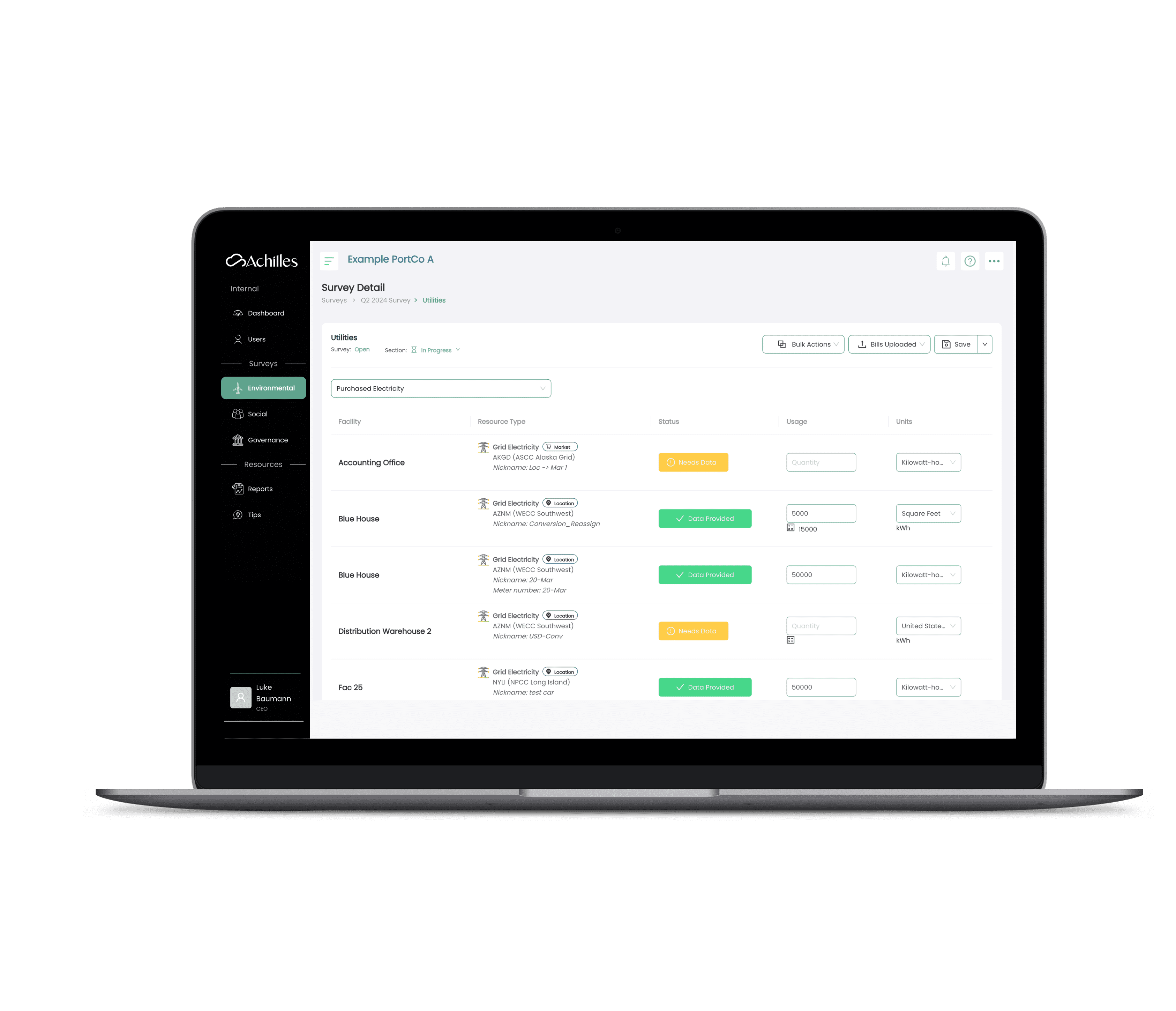
User-friendly and Affordable
Powerful tools and expertise – without the enterprise price tag
Achilles Carbon Accounting is designed to be affordable and user-friendly, making it accessible to a wide range of businesses, regardless of their size, industry, or ESG maturity. And better still, personalized customer support from our carbon experts is on-hand to guide your business through the carbon accounting process.
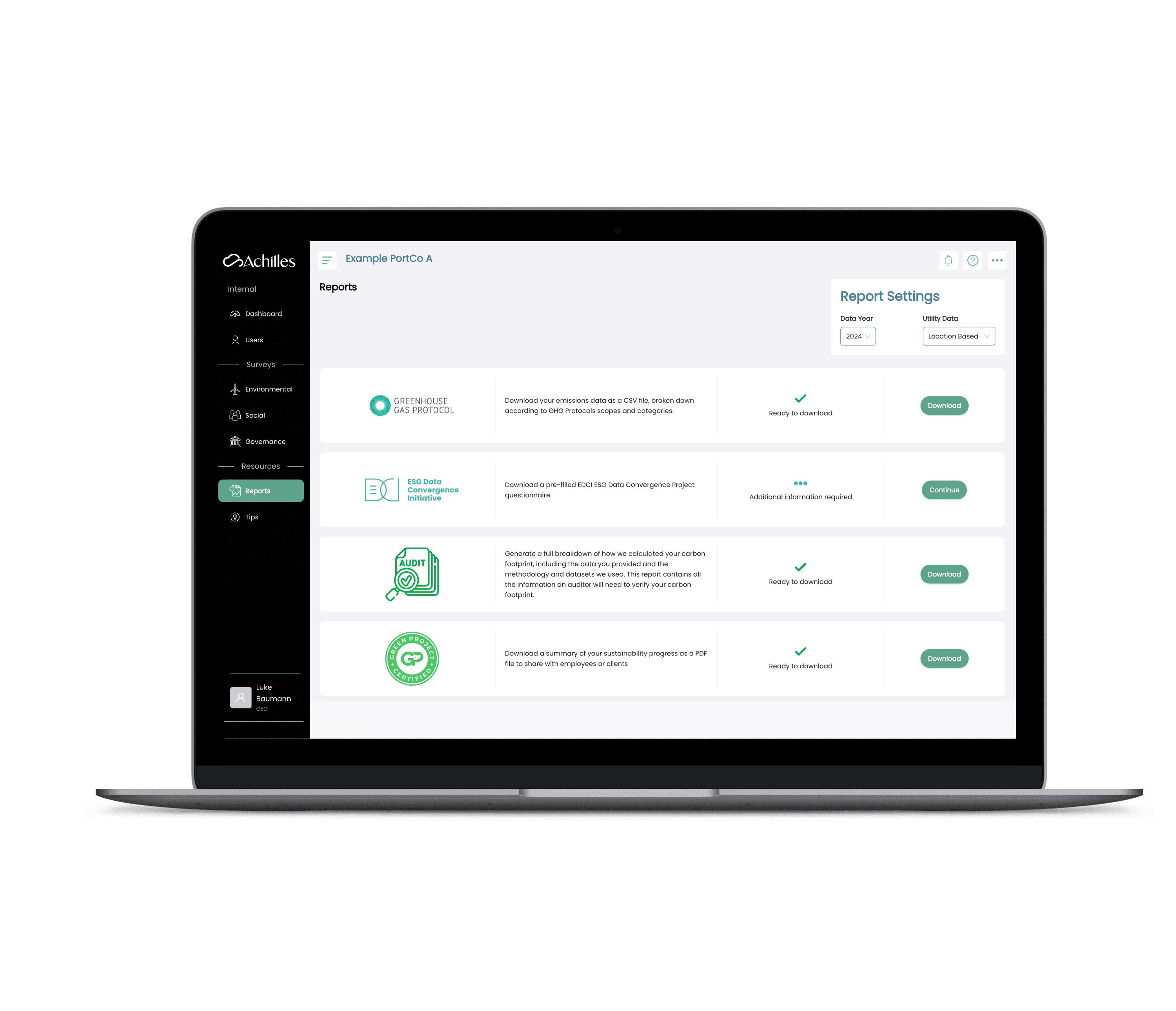

Achilles Carbon Management in Action
Reducing carbon emissions is a growing priority for organisations worldwide. Supply chain emissions, often the largest contributor to overall carbon impact, present both challenges and opportunities.
Our Achilles Carbon Management Solutions in Action White Paper explores how businesses are achieving real progress in managing and reducing emissions with Achilles.
WHY ACHILLES
Carbon Accounting That Goes Deeper and Delivers More

Global sustainability expertise
With 30+ years at the forefront of risk and compliance, Achilles brings unmatched understanding of sustainability and global supply chain risk management — essential for accurate carbon emissions reporting.

Practical tools for carbon reduction
More than just tracking, Achilles Carbon Accounting helps turn insight into action—supporting decarbonisation strategies across operations, energy use, and the supply base.
End-to-end ESG and risk management
From supplier due diligence to carbon accounting and non-financial reporting, Achilles offers an integrated set of tools to meet evolving business resilience, ESG compliance and sustainability goals – all in one place.

Independent audit and verification
Unlike other carbon accounting solutions, Achilles offers the option of internationally-recognised independent emissions auditing and verification to enhance your carbon credentials and meet decarbonisation goals.
FREQUENTLY ASKED QUESTIONS
Carbon Accounting FAQ: Everything You Need to Know
Understanding your carbon footprint is essential in today’s regulatory and sustainability landscape. Our Carbon Accounting FAQ answers the most common questions about emissions tracking, reporting frameworks, and how carbon accounting software can help your business meet climate targets and compliance obligations with confidence.
Carbon accounting, also known as greenhouse gas (GHG) accounting, is the process of measuring, tracking, and reporting carbon dioxide and other GHG emissions produced across an organization’s operations, products, and supply chains. It forms the basis for understanding a company’s climate-related impact and is the first step towards setting reduction targets, disclosing emissions, and meeting compliance standards.
- Scope 1: Direct emissions from owned or controlled sources (e.g., company vehicles, on-site fuel combustion).
- Scope 2: Indirect emissions from the generation of purchased electricity, steam, heating, and cooling consumed by the reporting company.
- Scope 3: All other indirect emissions that occur in a company’s value chain, including both upstream and downstream emissions (e.g., business travel, waste disposal, purchased goods and services).
It enables organizations to understand their environmental impact, comply with regulations, identify emission reduction opportunities, and demonstrate sustainability commitments to stakeholders.
The Greenhouse Gas (GHG) Protocol is the most widely used international accounting tool for government and business leaders to understand, quantify, and manage greenhouse gas emissions. Other standards include ISO 14064 (which can be achieved with the support of the Toitu Carbon Reduce program offered by Achilles) and the International Financial Reporting Standards (IFRS) S1 and S2 for sustainability-related disclosures.
- EU Corporate Sustainability Reporting Directive (CSRD): Mandates sustainability reporting for large companies operating in the EU.
- U.S. Securities and Exchange Commission (SEC) Climate Disclosure Rule: Not yet in force and subject of debate but sets out disclosure of material climate-related risks and GHG emissions requirements for US organisations.
- California Senate Bill 253: Mandates emissions reporting for companies doing business in California.
- United Kingdom – The UK plans to endorse the ISSB standards and integrate them into its sustainability disclosure requirements.
- Canada – Canada’s new Canadian Sustainability Standards Board (CSSB) is working closely with the ISSB to tailor the standards for national implementation.
- Australia – The Australian Sustainability Reporting Standards (AASB S1 & AASB S2) were formally approved in September 2024 by the Australian Accounting Standards Board.
- Japan – Japan’s Financial Services Agency has indicated its intention to use the ISSB as the foundation for future climate disclosure rules.
- Other countries, including Brazil, Singapore, and Mexico, are also aligning or considering alignment with the ISSB framework.
It depends on the jurisdiction and the size or type of the company. In many regions, large companies are required to report their emissions, and suppliers to these companies may also need to provide emissions data.
Data can be collected from various sources, including utility bills, fuel consumption records, supplier information, and transportation logs. Automated carbon accounting with platforms like Achilles Carbon Accounting streamlines this process.
Several tools and software platforms assist with carbon accounting, such as:
- GHG Protocol Calculation Tools: Excel-based tools with step-by-step guidance for emissions calculations.
- Carbon accounting software: Platforms like Achilles Carbon Accounting offer automated data collection, emissions calculations, and reporting features.
Scope 3 emissions encompass a wide range of indirect emissions across a company’s value chain, making data collection complex due to the involvement of multiple external parties and varying data quality.
Begin by identifying relevant categories within your value chain, such as purchased goods and services, business travel, and waste disposal. Engage with suppliers and partners to gather necessary data, and consider using spend-based or activity-based methods for estimation.
A carbon credit represents the reduction or removal of one metric ton of carbon dioxide or equivalent greenhouse gases from the atmosphere. Organizations can purchase carbon credits to offset their emissions, but it is recommended that credits are used only when other means of reduction have been exhausted.
While often used interchangeably, carbon credits are tradable certificates representing emission reductions, whereas carbon offsets refer to the actual projects or activities that reduce emissions, such as reforestation or renewable energy initiatives.
Start by assessing your current data availability and determining the appropriate boundaries for your emissions inventory. Employ standardized methodologies like the GHG Protocol, and consider engaging with experts or using specialized software like Achilles Carbon Accounting to facilitate the process.
Beyond regulatory compliance, carbon accounting can lead to cost savings through energy efficiency, enhance brand reputation, attract environmentally conscious investors and customers, and identify opportunities for innovation and improvement in operations.